SaaS pricing models in 2026: what 230 companies actually charge
Hybrid pricing overtook the flat fee this year. Investor preference points almost exactly the opposite way to what works when you have no investors.
Here are the six models with the real percentages, and which one to start on when nobody has paid you yet.
By Panche Isajeski · Tallinn
- Bootstrapped? Start with one flat price.
- Flat plus usage is where you end up, not where you start.
- Investors like the opposite of what works without them.
- If every run costs you money, know that cost before you pick a price.
Every pricing argument online is somebody's theory. This one is a survey: 230 B2B software companies, asked in May 2026 what they actually charge.
The numbers below are theirs. The line under each model is mine, from watching what happens on a payments platform when a bootstrapped maker picks the wrong one.
The six models at a glance
The number is how common each model is. The line under it is what to do when nobody has paid you yet.
Start here. One number on the page.
Where you end up, not where you start.
Only if a second user is the natural next step.
Only if the buyer can predict the bill.
Revisit at customer five.
Know your cost per run first.
Hybrid: 37%, and the fastest riser
Hybrid is now the most common model at 37% of companies, up from 25% a year earlier.
In practice it means a flat or seat fee plus metered AI usage on top.
If you are bootstrapped: start flat. Add a metered unit only once you know your cost per run to the cent.
Hybrid is where you end up, not where you start — it is two pricing decisions at once, and you have not made the first one yet.
Flat fee: 37% under $5M a year in revenue, and investors like it least
A flat subscription runs 37% of companies under $5M a year in revenue. Investor preference for it: 10% — the lowest of any model in the survey.
If you are bootstrapped: this is the right answer, and the investor number is why people talk you out of it. One number on the page.
A visitor decides in four seconds instead of opening a calculator. Investors are not the ones buying your product.
Per seat: 29% above $150M ARR, 5% investor preference
29% of companies over $150M ARR still price by seat. Investor preference is 5%. Seats are the model AI is eating, because the value stops tracking the headcount.
If you are bootstrapped: only if adding a colleague is the natural next step in the product.
For a single-user tool, skip it — you are adding a decision to the signup for revenue that is not there.
Usage: 24% investor preference
Usage-based pricing carries 24% investor preference. It works when the unit is something the buyer already counts: messages, runs, documents.
If you are bootstrapped: only if the buyer can see the unit before they pay. If they cannot predict the bill, they do not start.
An unpredictable invoice is a reason to churn that you never get told about.
Outcome: the investor favourite at 26%
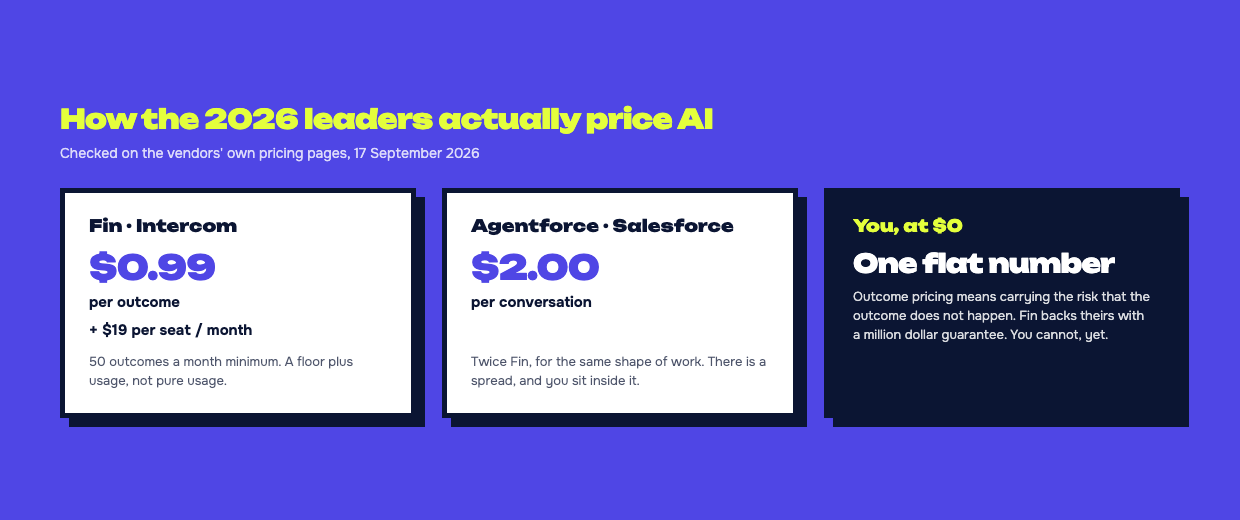
Pay per resolution, per booking, per lead — 26% investor preference, the highest in the survey.
If you are bootstrapped: hard before you have customers, because you cannot prove the outcome yet.
Outcome pricing is a claim, and a claim needs evidence you do not have on day one. Come back to it at customer five.
AI credits: 29% today, 33% planning it
29% of companies use credits today and 33% plan to add them within 6 to 12 months — about half of companies over $50M ARR by 2026.
The number that matters more: the median AI gross-margin target is 50%, not the 70 to 80% of classic SaaS.
If you are bootstrapped: credits price your margin, not your time. If every run costs you money, know that cost to the cent before you pick a number.
A model that loses you money at scale is worse than no customers.
What investors prefer
Share of investors naming each model as their preference. The survey reports this for four of the six.
The pattern worth noticing
Read the investor column and the bootstrapped column next to each other and they disagree almost everywhere.
Investors prefer outcome and usage, because those compound with a sales team and a funded runway behind them.
The flat fee they like least is the one that works when you are the sales team and the runway is your savings.
That is not investors being wrong. They are pricing a different company than the one you are running.
Most pricing advice online is written for the funded version, and it is the single most expensive thing a bootstrapped maker copies.
And before any of this matters you have to be able to take the money at all.
If you do not have a company yet, start there: get paid without opening one.
Source: Growth Unhinged, The state of B2B monetization in 2026, 13 May 2026, survey of 230 companies. Percentages are theirs; the bootstrapped reading of each is mine.